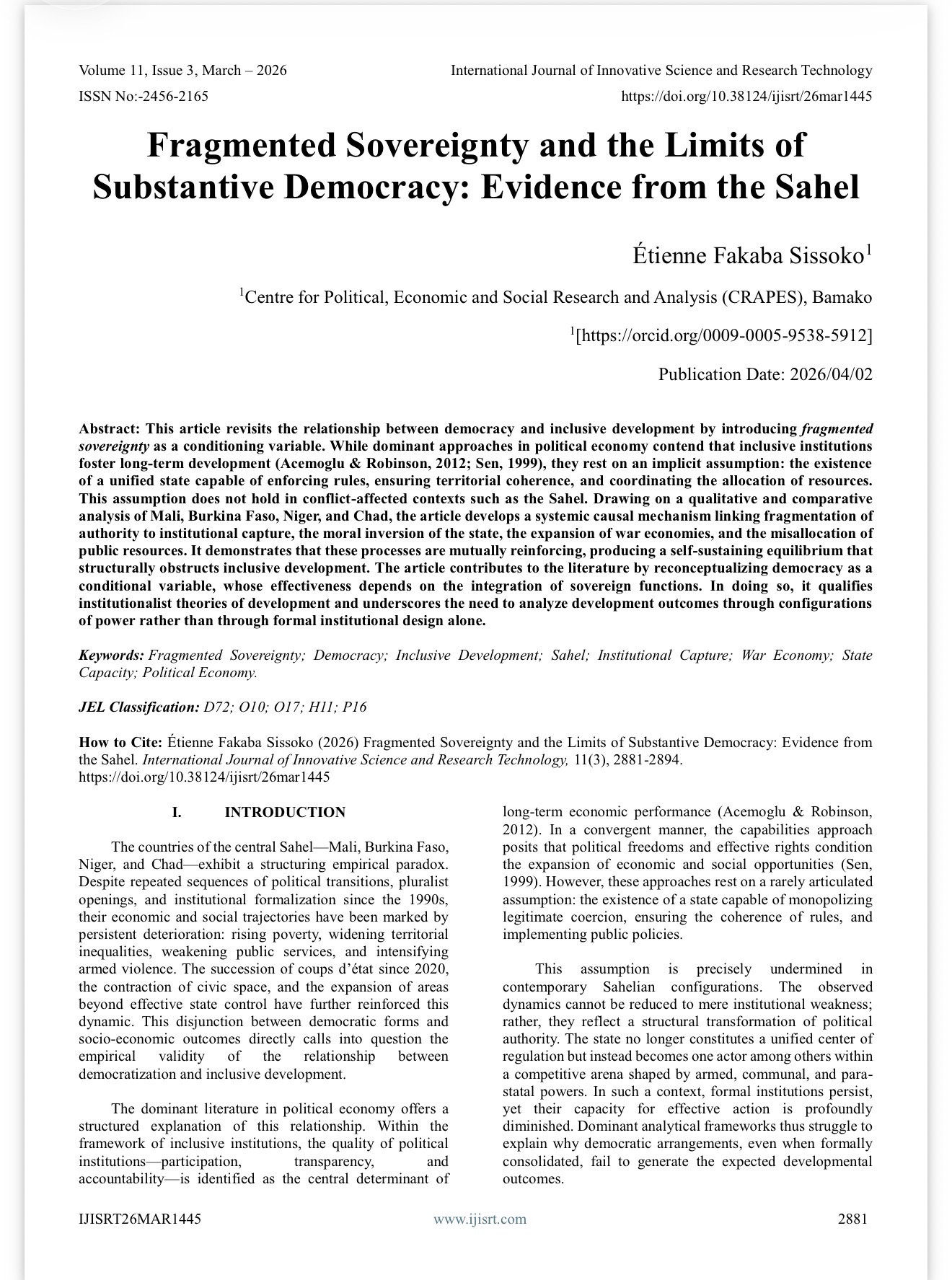
Abstract : This article revisits the relationship between democracy and inclusive development by introducing fragmented sovereignty as a conditioning variable. While dominant approaches in political economy contend that inclusive institutions foster long-term development (Acemoglu & Robinson, 2012; Sen, 1999), they rest on an implicit assumption: the existence of a unified state capable of enforcing rules, ensuring territorial coherence, and coordinating the allocation of resources. This assumption does not hold in conflict-affected contexts such as the Sahel. Drawing on a qualitative and comparative analysis of Mali, Burkina Faso, Niger, and Chad, the article develops a systemic causal mechanism linking fragmentation of authority to institutional capture, the moral inversion of the state, the expansion of war economies, and the misallocation of public resources. It demonstrates that these processes are mutually reinforcing, producing a self-sustaining equilibrium that structurally obstructs inclusive development. The article contributes to the literature by reconceptualizing democracy as a conditional variable, whose effectiveness depends on the integration of sovereign functions. In doing so, it qualifies institutionalist theories of development and underscores the need to analyze development outcomes through configurations of power rather than through formal institutional design alone.
Loading Viewer…
Keywords : Fragmented Sovereignty; Democracy; Inclusive Development; Sahel; Institutional Capture; War Economy; State Capacity; Political Economy